
Algiers
Algiers is a city rich in history, where you can see many layers of the past: the bazaar, places of worship from different religions, and the scars of the recent war. Sarajevo is a place that tries to move forward without forgetting its past.
Algiers: Between History and Everyday Life.
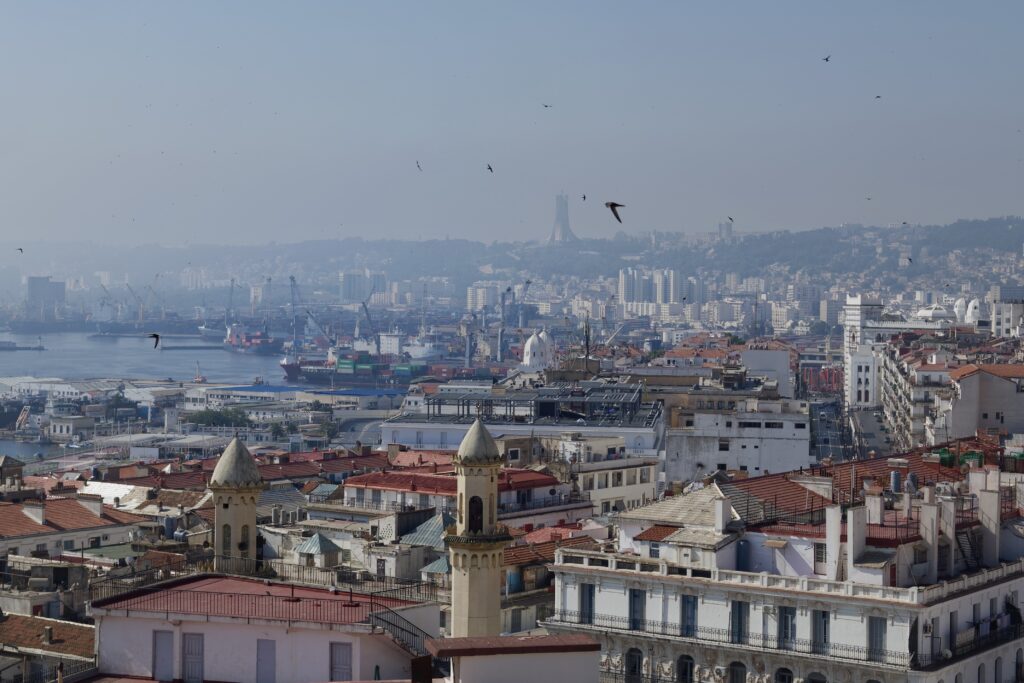
Algiers surprised me with the height and beauty of its French-era buildings. Walking near the Casbah, I sometimes felt as if I were in an older, more mysterious version of Paris. From my hotel rooftop, I could see the port, the Casbah and the dense neighbourhoods stretching across the hills. The panorama revealed a city of striking contrasts.
The Casbah itself deserves time. Its narrow streets and buildings carry layers of history, but parts of this historic quarter are in need of repair. I hope the authorities and local communities can preserve this remarkable part of Algiers.
While exploring the Casbah, I met locals who showed me around, and some even offered to share a meal with me. I was advised to avoid wandering through the Casbah in the evening, out of respect for residents’ privacy and everyday life.
French was useful throughout my journey, although English also opened doors to some interesting conversations. If you don’t speak Arabic, knowing a little French can make travelling around Algeria easier.
Algiers: Architecture, Space and Light
Around the Grande Poste, Algiers reveals a different side of its character. The famous neo-Moorish post office is one of the most striking buildings in the area, but what fascinated me was not just the architecture itself. It was the way the buildings, the park and the surrounding open spaces come together to form an urban setting that feels remarkably well proportioned.
There is a sense of human scale here that I find particularly appealing. Despite the grandeur of the architecture, the spaces do not feel overwhelming. The buildings relate to one another in a way that leaves room to breathe, to walk around and to appreciate the surroundings. Beauty, grandeur and function seem to coexist naturally.
This part of Algiers is worth visiting both by day and by night. In daylight, the different volumes and proportions become more apparent, and you can appreciate how the buildings occupy and define the surrounding space. After dark, the lighting gives the architecture a different presence. Illuminated façades stand out against the night, highlighting details that might otherwise go unnoticed and lending the buildings an almost sculptural quality.
The setting changes with the light, but the appeal remains. It is a place to slow down, look around and appreciate how architecture can shape the experience of a city.
Walking Algiers: From the Casbah to Notre-Dame d’Afrique and the Waterfront
From my hotel near the Casbah, the Afric Hotel, I set out west towards Bab El Oued. This part of Algiers offers a different experience from the city’s main sights. An old French-era street clock stands at a crossroads, surrounded by the bustle of a local fruit market. Vendors sell their produce, people move between the stalls, and the streets are filled with the sounds of everyday life.
The surrounding buildings are beautiful, with elaborate façades and architectural details that invite a closer look. Some are better maintained than others, and the signs of everyday life have become part of their appearance. Colourful curtains and other improvised coverings appear against the older architecture, creating an interesting contrast between the buildings’ original design and the ways people use them today.
The streets are not particularly immaculate, but they are perfectly walkable. People were friendly, and there was always something happening: some were hurrying towards prayer, while vendors were packing up their carts and gathering the produce they had not sold. It felt like an opportunity to see Algiers beyond its best-known landmarks, in a neighbourhood where ordinary life carries on around buildings that have witnessed several generations.
From here, I continued towards the former Hôpital de Saint-Eugène. The walk downhill is quite steep, but the views make it worthwhile. Looking out over the sea and the city, I could still see Notre-Dame d’Afrique standing on its hill. The combination of the buildings, the surrounding hills, the sea and the activity of the neighbourhood made this one of the places I particularly enjoyed exploring.
Before heading uphill to the basilica, I also visited a beach in Bab El Oued. It wasn’t the most inviting beach, and the water didn’t look particularly appealing, but it was good to see that people had somewhere to swim within the city. The atmosphere was lively. Families came with their children, mothers kept an eye on them as they ran around, and young people jumped into the water from boats and wave breakers. People were swimming, refreshing themselves and enjoying their time together. It was an ordinary scene of summer life, full of movement and noise.
From the beach, I took a taxi uphill towards Notre-Dame d’Afrique to save time and energy and, above all, to enjoy the views.
The basilica was already closed when I arrived, so I couldn’t visit the interior. Even so, the exterior and the panorama made the journey worthwhile. Algiers spread out below me, with its white buildings, the blue sea and the greenery covering the slopes. The basilica occupies a striking position on a hill projecting towards the bay, offering views in several directions. Looking west, I could see the more residential parts of the city; elsewhere, the white buildings seemed to stretch between the green slopes and the blue water.
The combination of these colours and the way the city sits within the landscape gave the view a particular appeal. For me, this was one of the main reasons to visit Notre-Dame d’Afrique.
I walked back down rather than taking another taxi. The descent was interesting, although walking alongside passing traffic was not always pleasant. I chose a different route through the neighbourhoods, passing small, single-storey houses as well as larger and more stylish buildings. There was nothing spectacular about this part of the walk, but that was precisely the point: it offered another glimpse of Algiers, beyond the places that usually appear in photographs.
Later, I returned towards the waterfront and continued east from the military port along an elevated boulevard lined with arcaded buildings. The port facilities lay below, separated from the street by a busy highway. Looking out towards the sea, I could see the fishing port and other harbour installations extending towards the city centre.
The architecture was one of the highlights. The arcades give the buildings a distinctive appearance, while their façades reveal a mixture of architectural influences. French-era urban design and Moorish elements come together in ways that make Algiers difficult to mistake for another city.
The waterfront was a welcome change after the city’s busy streets. I wanted a little quiet and a chance to look towards the sea. However, this is not a promenade where you can simply walk down to the water whenever you feel like it. The port infrastructure limits access, and the boulevard itself remains busy with traffic. There is also relatively little shade. More trees and sheltered public spaces would make the walk more comfortable, particularly during the warmer months.
Nevertheless, the elevated position offers an impressive perspective on the relationship between the city and its port. It is a view worth taking the time to appreciate, even if the experience is different from walking along a conventional